




Dear Reader,
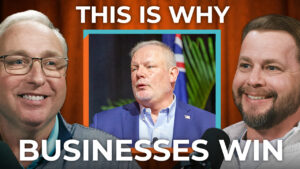
Collin Hathway brought Private Equity into the home service space.
And it wasn’t easy. At the time, PE wasn’t interested in plumbing, heating, or air conditioning. But Collin knew that the residential home service space had some very attractive qualities:
- It is recession-proof.
- It produces consistent cash flow.
- It was underleveraged.
- It is filled with people of high moral character.
These qualities attracted Collin to the space, so he started looking for deals.
One of the first deals he found was Berkeys in Dallas. That was quickly followed by Abacus in Houston.
I was training and consulting with Alan at the time and was there for the early days of Collin’s entry into the space.
When I met Collin, I was immediately impressed by three things:
- He was young.
- He was a confident Stanford graduate.
- He had a very casual air about him—he came across as approachable. Not a jerk at all.
What I later learned in our interview with Collin was that he was also:
- Broke.
- Brave.
- Bold.
Yeah—he was B.R.O.K.E. BROKE. He had less than $15,000 to his name when he acquired Berkeys, and he was bleeding off $1,200 at the end of each month.
So, how does a broke kid with no money buy not just one, but two of the largest plumbing and HVAC companies in Texas?
He was brave, bold, and smart. You’ll hear all about it in the show today.
I asked Alan after the show:
“Alan, did you know Collin only had $15,000 to his name when you signed the deal?”
“No, Todd, I did not,” said Alan.
“Would you have done the deal had you known?” I asked.
“No, Todd, I would not,” Alan smiled.

In This Episode, You'll Learn:
- Why private equity isn’t always cold—and how partnerships can thrive
- How Colin started in the trades (and almost lost it all)
- The power of keeping deals simple and human
- Lessons from surviving heart attacks and economic crises
- How the future of home services depends on real leadership, not just scale
Episode Chapters & Summary
Private Equity with a Personal Touch
“Private equity doesn't have to be cold. It can be a partnership at best.”
Colin opens up about his belief that true partnerships are built on trust, simplicity, and mutual respect. While private equity often gets painted as ruthless, Colin proves that relationships and shared values matter even in big-money deals.
Key Takeaways:
- Partnerships thrive on trust and transparency
- Private equity can be collaborative, not just transactional
- Mutual respect drives better long-term outcomes
- Personal connection makes business more than numbers
From Stanford to Plumbing: Colin's Unexpected Journey
“My friends were apoplectic. They said, 'Why would you ever buy a plumbing company?'”
Colin shares how he defied elite expectations to dive into the trades. Despite skepticism, he saw stable opportunities where others saw blue-collar work. The move wasn't easy—but it laid the foundation for industry-shaping deals to come.
Key Takeaways:
- Opportunity often hides where others aren't looking
- The trades offer stability—even in recessions
- Entrepreneurship requires courage to ignore critics
- Sometimes the best moves look crazy from the outside
Why Simplicity Beats Complexity in Deals
“Things aren't that complicated. I just try and keep it really simple.”
Colin and Alan explain why complex PowerPoints and financial gymnastics often ruin deals. Whether raising money or negotiating partnerships, Colin believes clarity wins—and whiteboards beat slide decks every time.
Key Takeaways:
- Simple deals are easier for everyone to trust
- Owners respect clarity over jargon
- Whiteboarding can build fast alignment
- Over-complication hides true intentions
Learning from Hard Times (and Heart Attacks)
“I think I realized that I didn't have as much control as I thought I did.”
Colin reflects on his heart attack at 36, business betrayals, and the lessons of surviving turbulent markets. Vulnerability and honesty run through his story—and he credits hardship with teaching him what really matters in life and leadership.
Key Takeaways:
- Stress and health are deeply connected for entrepreneurs
- Hardship clarifies true priorities
- Financial wins mean little without personal well-being
- Adversity shapes better leaders
Building Companies for the Next Decade
“I think the ones who are built the right way are going to win.”
Looking forward, Colin explains that scale alone won't secure victory in home services. The future belongs to companies investing in people, operational excellence, and organic growth—not just financial engineering.
Key Takeaways:
- Real leadership will define future winners
- Overhead bloat kills agility and culture
- Organic growth beats fast flips in the long run
- Culture and people remain the ultimate differentiators